

How to Choose and Manage a Business Investment Account
Managing corporate cash effectively requires more than keeping funds in a standard checking account. A dedicated business investment account helps companies earn yield, maintain liquidity, and hedge against inflation. This guide covers account options, safety protections, tax rules, and setup steps to optimize your corporate reserves.
What Is a Business Investment Account?
Holding excess cash in a standard commercial checking account creates a hidden cost for growing companies. Inflation steadily erodes purchasing power over time. A business investment account gives enterprises a formal vehicle to put surplus reserves to work. These specialized accounts allow legal business entities to purchase stocks, bonds, money market mutual funds, and Treasury securities.
A business investment account functions differently from a personal trading account. It is owned directly by a legal corporate entity rather than an individual. Opening and managing one requires official business documentation, specific tax considerations, and board or owner authorization. Managing corporate capital through an investment account requires matching risk exposure to corporate cash flow cycles.
How Cash Accumulation Impacts Corporate Treasury
Leaving large cash balances idle in checking accounts creates an opportunity cost for any enterprise. Modern business treasury management divides cash reserves into distinct functional tiers. Operating capital covers short-term bills, vendor payments, and regular payroll needs. Secondary cash forms an emergency buffer for unexpected operational shifts. Tertiary capital represents surplus reserves intended for long-term growth.

A dedicated business investment account handles secondary and tertiary cash reserves. Moving money out of primary operating accounts prevents accidental overspending. It turns idle cash into active yield through dividend disbursements, interest payments, or asset growth.
Key Types of Business Investment Accounts
Companies select investment vehicles based on liquidity schedules, risk tolerance, and cash management goals. Understanding available options helps treasury managers choose the right account structure.
Business Brokerage Accounts
A business brokerage account provides access to standard financial markets. Through a commercial brokerage, companies can buy individual stocks, corporate bonds, exchange-traded funds (ETFs), and mutual funds.
These accounts offer strong capital growth potential for long-term reserves. However, equity investments involve market volatility and risk. Stock prices shift based on broader economic cycles and industry conditions.
Taxable business brokerage accounts offer zero automatic tax protection. Capital gains, dividend distributions, and interest earned create annual taxable events for the firm.
Business Money Market Accounts vs. Money Market Funds
Business owners often confuse bank money market accounts with brokerage money market funds. The two financial products use completely different structural frameworks.
A business money market account (MMA) is a bank deposit account. It pays fixed or variable interest and offers standard federal deposit insurance. MMAs provide high liquidity and often include check-writing options.
Conversely, a business money market fund is a mutual fund held inside a brokerage account. It invests in short-term debt instruments like Treasury bills and commercial paper. While money market funds aim to maintain a stable net asset value, they lack bank deposit insurance.
Business Treasury Accounts
Business treasury accounts focus specifically on government-backed debt securities. Their primary focus is short-term Treasury bills, commonly known as T-bills. T-bills mature across schedules ranging from four weeks to fifty-two weeks.
These accounts suit enterprises prioritizing capital preservation over speculative growth. Treasury securities carry the backing of the federal government. They allow business owners to secure reliable yields while avoiding local and state income taxes on interest.
Business Cash Management Accounts
Cash management accounts blend checking account functionality with automated investment sweep rules. Financial technology platforms and brokerages offer these hybrid structures. Uninvested cash automatically sweeps into a network of partner financial institutions.
This sweeping process divides large cash amounts across multiple banks. As a result, companies expand total deposit protection far past standard single-bank limits.
Evaluating FDIC Insurance vs. SIPC Protection
Safeguarding corporate funds against financial institution failure requires understanding two distinct regulatory systems. Bank accounts and investment accounts rely on different consumer protection organizations.
FDIC Coverage Limits for Corporate Deposits
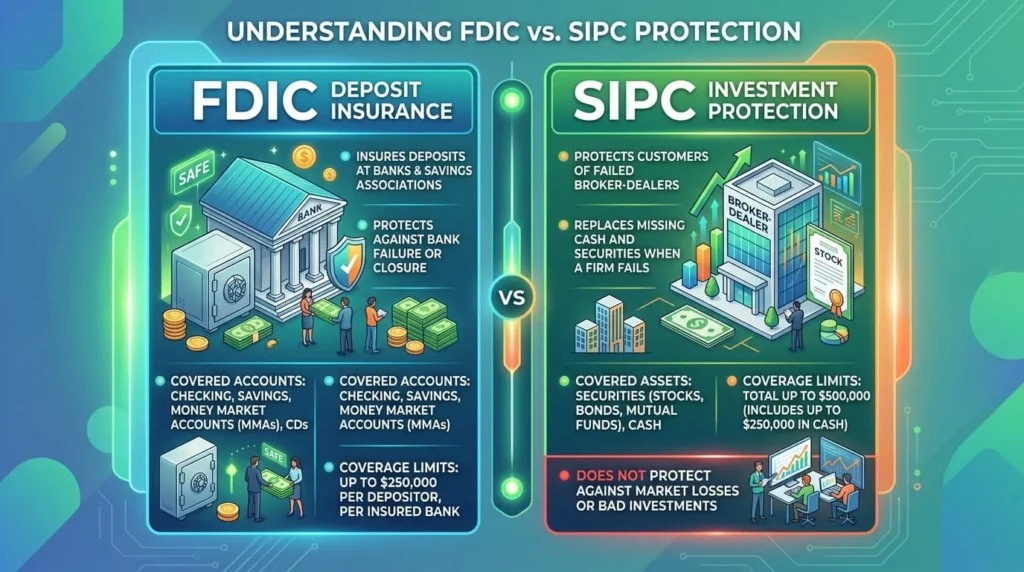
The Federal Deposit Insurance Corporation (FDIC) covers commercial bank deposits during bank insolvencies. Standard FDIC insurance protects up to $250,000 per depositor, per insured financial institution.
For corporations, limited liability companies, and partnerships, coverage applies to the legal entity. It does not multiply by the number of business partners or owners. Holding cash over $250,000 in a single bank leaves excess funds exposed if that bank fails.
Bank sweep networks solve this exposure issue. They automatically distribute business cash into $250,000 increments across dozens of partner banks.
SIPC Coverage Limits for Investment Securities
When placing funds into a business brokerage account, FDIC coverage no longer applies. Instead, securities receive protection from the Securities Investor Protection Corporation (SIPC).
SIPC protects accounts if a registered brokerage firm fails financially. It does not shield against market trading losses or poor investment performance.
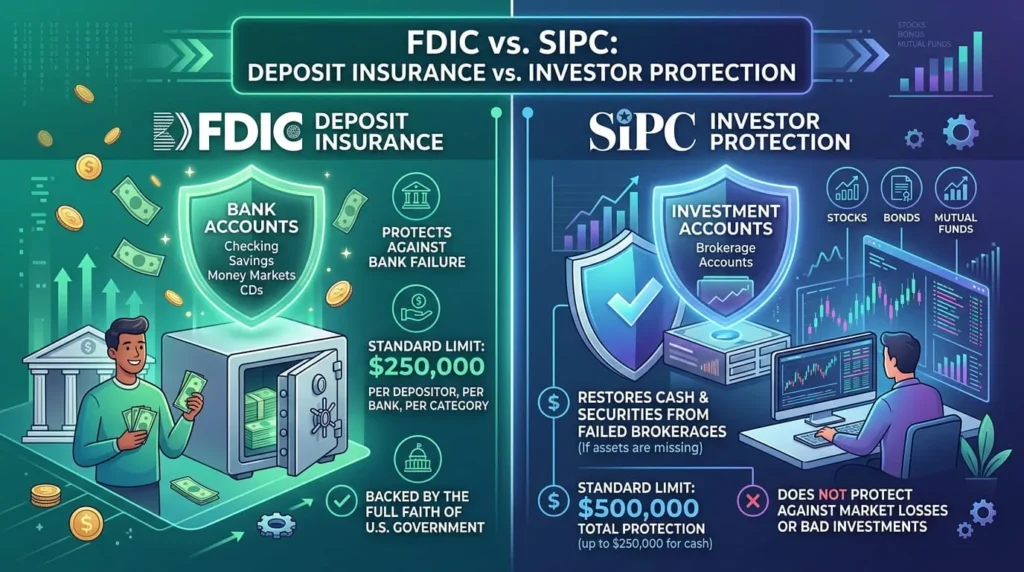
SIPC insurance covers up to $500,000 in total securities per business entity. That amount includes a $250,000 maximum sub-limit for uninvested cash. Many major institutional brokerages buy supplemental private insurance policies to protect institutional balance sheets above standard SIPC caps.
Tax Considerations for Business Investment Accounts
Operating a business investment account requires ongoing attention to tax obligations. Investment income, capital gains, and dividend payouts impact annual corporate tax returns.
Capital Gains Taxes and Loss Harvesting
Realized investment profits inside a taxable account generate capital gains taxes. Short-term capital gains apply to assets sold after being held for one year or less. These gains are taxed at ordinary corporate income rates.
Long-term capital gains apply to investments held for more than one year. Tax rates for long-term gains depend directly on your specific corporate legal structure.
Enterprises can utilize tax-loss harvesting to manage tax liabilities. Selling underperforming holdings at a loss offsets realized capital gains. This strategy directly lowers total corporate taxable income for the tax year.
Tax Differences Across Business Structures
Tax rules apply differently based on corporate legal entity types:
Pass-Through Entities: Sole proprietorships, partnerships, and S Corporations pass investment earnings directly to owner tax returns. Individual tax rates apply to all investment profits.
C Corporations: C Corporations pay corporate income tax rates on investment gains and interest. Dividends distributed to owners face second-tier personal income taxation.
Limited Liability Companies: LLCs follow their selected tax filing status, defaulting to pass-through rules or electing corporate classification.
Interest income earned from federal Treasury securities remains exempt from state and local income taxes. This feature makes Treasury assets attractive for companies operating in high-tax states.
How to Choose the Right Investment Strategy
Developing an effective corporate investment plan requires matching cash positions to business operational cycles. Cash reserves should never be invested without clear liquidity schedules.
Determining Operating Reserves vs. Excess Liquidity
First, establish your company cash burn rate and recurring expenses. Financial advisors recommend retaining three to six months of operating capital in liquid checking or savings. Keeping operational funds in traditional accounts ensures immediate access for payroll, supplies, and emergency costs.
Surplus capital beyond operating requirements can be allocated across tiered investment options. Short-term excess goes into money market funds or Treasury bills. Long-term strategic reserves can be placed into diversified stock or bond index funds.
Evaluating Horizon and Yield Expectations
Every corporate cash decision requires balancing yield against liquidity and risk:
Daily Operating Funds: Requires zero market risk, full liquidity, and yield options like interest checking or sweep accounts.
Near-Term Liquidity Reserves (3 to 12 months): Features low market risk, strong capital preservation, and predictable returns via T-bills or CDs.
Long-Term Reserves (2 or more years): Accepts moderate market risk in exchange for growth potential using stock and bond ETFs.
How to Open a Business Investment Account
Setting up a business investment account involves stricter administrative requirements than personal brokerage accounts. Financial institutions must enforce federal identity verification rules and legal authority checks.
Required Documentation and Formation Documents
Before starting an application, gather these primary organizational documents:
* Federal Employer Identification Number (EIN) confirmation letter from the IRS.
* Filed Articles of Incorporation or Articles of Organization.
* Corporate Operating Agreement or Corporate Bylaws detailing governance rules.
* Corporate Resolution document granting explicit authority to open and manage investment accounts.
* Personal identification details and photo IDs for beneficial owners owning 25 percent or more of the company.
* Physical business address verification and contact information.
* Existing commercial checking account details for linking electronic fund transfers.
Account Setup and Funding Steps
After collecting corporate documentation, follow these practical steps to open your account:
1. Select a commercial brokerage or financial institution that offers corporate entity accounts.
2. Complete the corporate account application using exact legal entity details.
3. Upload formation documents, beneficial ownership forms, and corporate resolutions.
4. Link your primary commercial checking account via bank verification.
5. Wire initial capital reserves into your new investment account.
6. Set automated sweep rules or execute initial portfolio purchases according to your strategy.
